
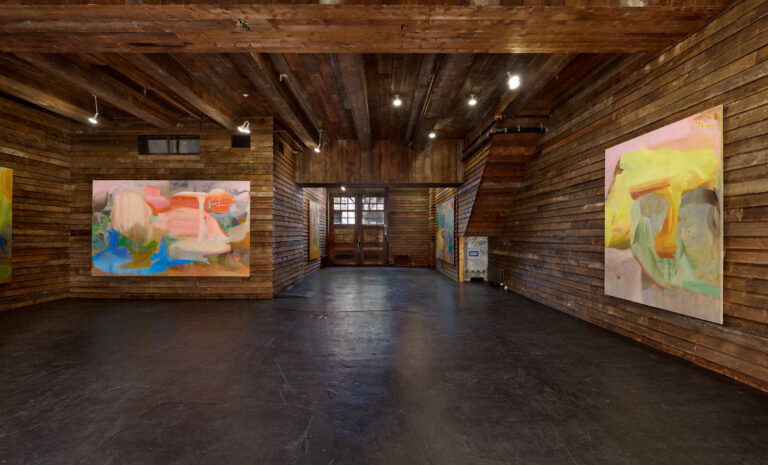
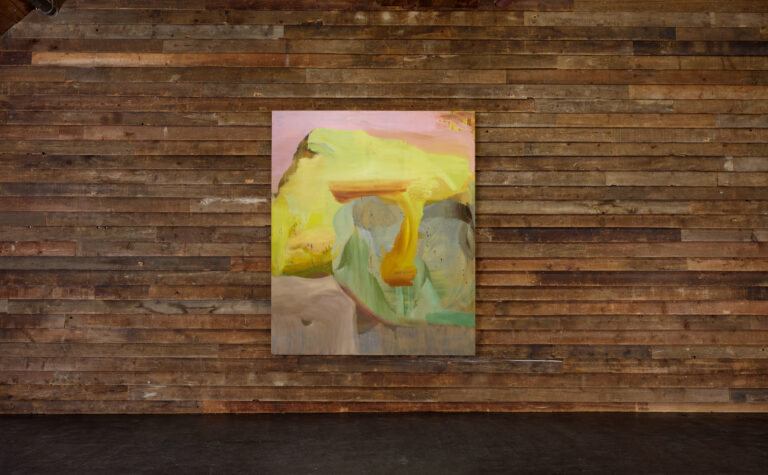
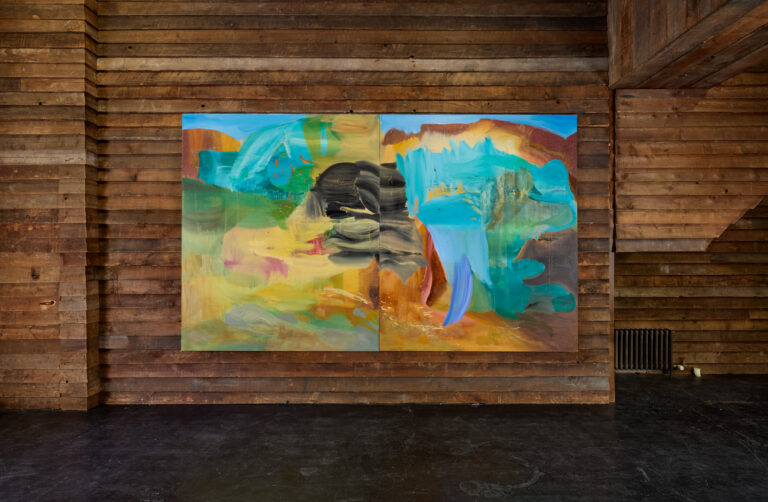
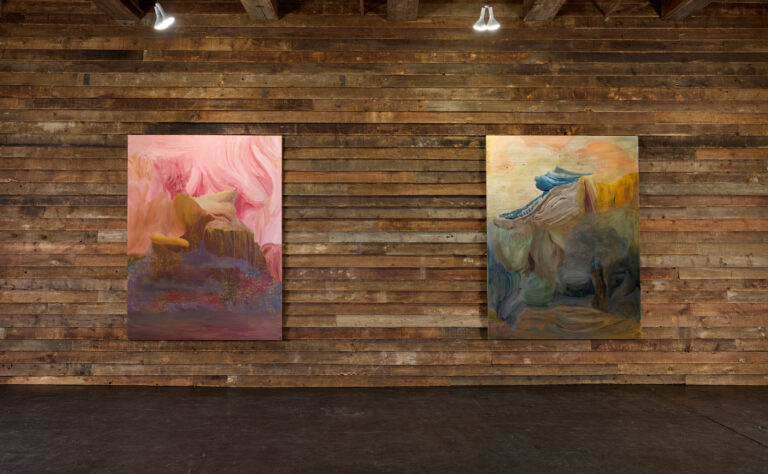
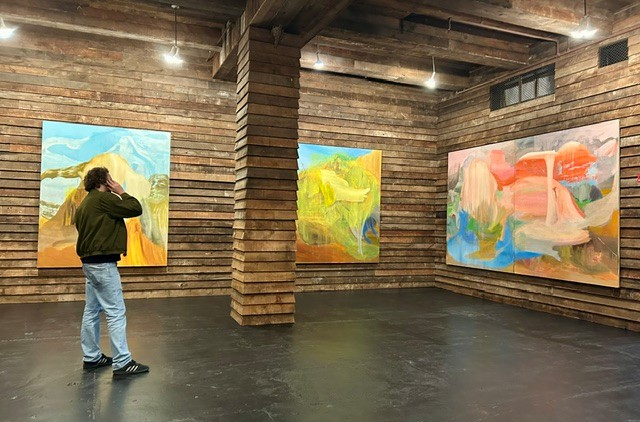
Milko Pavlov has recently garnered significant attention with his debut solo exhibition in the United States, which opened at the Julian Schnabel Foundation in May 2026. This exhibition represents a key moment for the artist, introducing his distinctive abstract painting practice to a prominent American audience. The show underscores Pavlov’s unique approach to composition, where pictorial elements are in continuous motion, reflecting his investigative process into the very nature of painting and perception.
The impetus for this notable US showing began with a fortuitous encounter in 2021. Pavlov, while visiting Galerie Max Hetzler, was observed by Julian Schnabel and his son, Cy, intently examining Schnabel’s artworks. This shared artistic sensibility led to an introduction, during which Pavlov presented images of a prior exhibition he had held in a German church. This initial connection rapidly developed into a working relationship, with Cy Schnabel subsequently organizing an exhibition in San Sebastián and offering Pavlov representation through his Madrid-based gallery, Villa Magdalena.
Pavlov’s current exhibition at the Julian Schnabel Foundation further explores his ongoing preoccupations with painterly processes, spatial instability, and the psychological impact of color. His works, which deliberately blur the lines between naturalism and abstraction, are presented as sustained investigations. This recent activity reinforces his growing presence in the international art scene and the increasing recognition of his distinctive artistic philosophy, which adeptly fuses historical influences with contemporary scientific and philosophical thought.
Themes
Pavlov’s paintings navigate the liminal space between naturalism and abstraction, frequently presenting only subtle suggestions of landscapes or figurative forms. His practice prioritizes a rigorous investigation of painting itself, moving beyond mere image-making to explore the inherent processes and materialities of the medium. This approach is characterized by a dynamic refusal of stasis, where pictorial elements are in constant flux, advancing and receding, merging and contradicting one another. The energetic interplay of color and the unstable figure-ground relationships within his works are often achieved through his command of watercolor and frottage techniques, contributing to a sense of continuous transformation.
Energetic swaths of contrasting hues, such as turquoise juxtaposed against yellowish black, reflect a contemporary understanding of color as an ‘engine of ongoing change and metamorphosis’ rather than a static theoretical construct. Pigments are layered to create assemblies that press forward and dissolve back into space, blurring conventional boundaries and rendering it unclear where one element begins and another ends. This creates a perceptual experience that is as much psychological as it is optical, inviting viewers into a process of spiritual transformation mediated through color and space.
Conceptually, Pavlov integrates an abiding interest in quantum physics into his artistic thought process. He engages with philosophical thought experiments, from Schrödinger’s cat to Plato’s cave, while developing his paintings. This intellectual curiosity extends to his unique practice of dating his artworks in the future, which he likens to a form of speculative archaeology. Pavlov envisions himself as a ‘time traveler’ on a quest to uncover unseen art, embodying a belief that art inherently holds and offers hope for the future.
Biography
Milko Pavlov was born in 1956 in Aytos, Bulgaria, growing up in a household with two doctors. His formative artistic experiences began with medical illustrations and later, as he came of age prior to the collapse of the Eastern Bloc, through explorations of the National Museum. There, he became captivated by the reverse perspective employed in medieval Christian icons. This artistic mode, which collapses depth and brings the background forward, creating a unique space of encounter, laid a foundational influence for Pavlov’s later artistic explorations into spatial instability and psychological perception within his own paintings.
A significant turning point in Pavlov’s career occurred in 2021 when he was discovered by Julian Schnabel and his son, Cy, at Galerie Max Hetzler. His intense scrutiny of Schnabel’s paintings caught their attention, leading to an introduction and a subsequent sharing of images from a previous exhibition Pavlov had held at a church in Ratingen, Germany. This chance encounter quickly blossomed into further collaborations, including an exhibition curated by Cy Schnabel in San Sebastián and representation by Schnabel’s Madrid-based gallery, Villa Magdalena.
Pavlov’s artistic journey culminated in his inaugural solo exhibition in the United States at the Julian Schnabel Foundation in May 2026. This exhibition marked a pivotal moment for the Bulgarian-born, Berlin-based painter, introducing his distinct vision and complex intellectual framework to a new critical landscape. His fluent command of multiple languages, including English, French, Spanish, Italian, German, and Bulgarian, further highlights his international scope and engagement within the contemporary art world.
Text: Heni News (May 2026) www.heni.com